Maisan Provincial Park: Driving to Korea's Twin Horse Ear Peaks
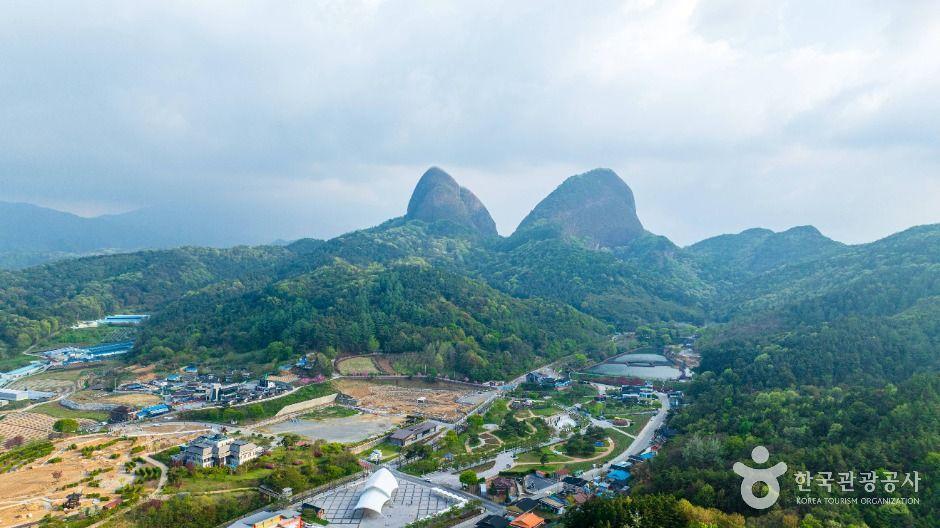
There's a moment on the drive into Jinan when the hills part and two conical peaks appear on the horizon, rising symmetrically from the surrounding ridgelines. From a distance, they look almost artificial — too perfect, too symmetrical to be natural. These are Maisan (마이산), literally "Horse Ear Mountain," and they're unlike anything else in Korea.
The peaks have been drawing pilgrims, painters, and curious travelers for centuries. Today the road from Jeonju takes about 45 minutes. From Seoul it's a 3-hour drive — and an easy combination with nearby Boseong tea fields or the historic city of Jeonju if you want to make a weekend of it.
Getting to Maisan
From Seoul, follow the Honam Expressway (Route 25) south toward Jeonju, then take the Jinan IC exit and head southeast on National Route 26. The drive is about 250 km and takes 2 hours 45 minutes to 3 hours in normal traffic. Maisan has two entrances — the North Entrance (북부 주차장) near Jinan town, and the South Entrance (남부 주차장) closer to Tapsa Temple. Most visitors park at the north entrance and walk through to the south.
- From Seoul: ~250 km, 2 hrs 45 min–3 hrs via Honam Expressway → Jinan IC → Route 26
- From Jeonju: ~40 km, about 45 minutes via Route 26
- Tolls (Seoul → Jinan, one-way): ~11,000–14,000 KRW
- Parking: Both north and south entrances have paid lots (~3,000 KRW)
- Navigation: Enter '마이산도립공원' (Maisan Provincial Park) in Naver Map
- Entry fee: ~3,000 KRW adults (ticket covers both entrances)
The Twin Peaks: What Makes Maisan Unusual
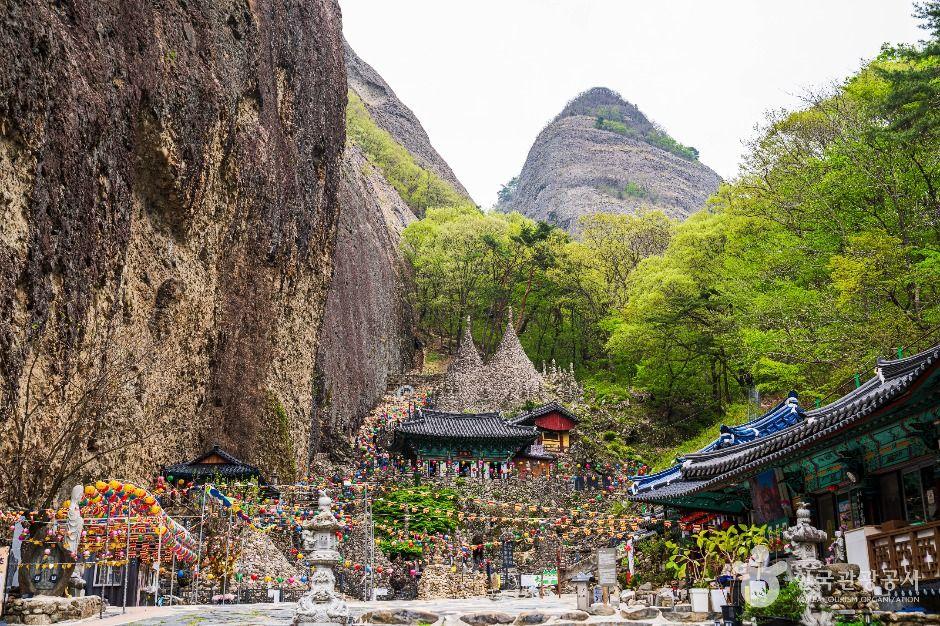
Maisan's two peaks are Sutbong (수봉, the taller "male" peak at 680 m) and Amabong (암봉, the "female" peak at 673 m). What makes them remarkable isn't their height — Korea has many taller mountains — but their shape. Both peaks are near-perfect cones of rhyolite tuff, a type of volcanic rock, rising sharply from otherwise gentle hill country. They look less like eroded mountains than like two enormous stone spires that were placed there by hand.
The peaks appear differently depending on the season. In spring, Koreans call them Dotdaesan (돛대산, "Mast Mountain") because they rise from a sea of blossoms. In summer, the lush green makes them look like an Emerald Mountain. In autumn they're called Maisan proper. And in winter — bare and stark against the snow — they're Munpilbong (문필봉, "Writing Brush Peak"). Coming in any season, you're seeing a different mountain.
Tapsa Temple: 108 Stone Pagodas Built Without Mortar
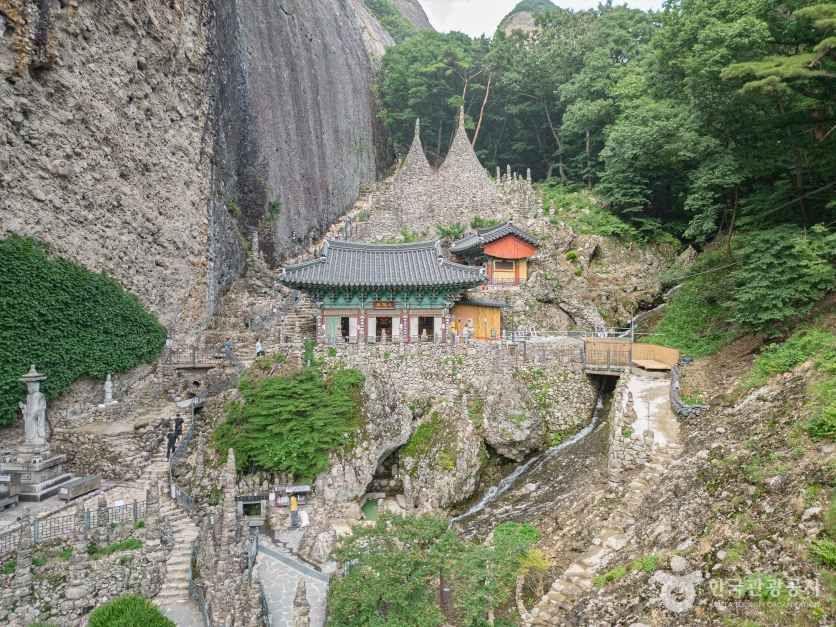
At the base of the peaks, wedged between the cliff face and a rocky stream, is Tapsa Temple (탑사) — and it's the most surprising thing about Maisan. The temple grounds are filled with 108 stone pagodas of varying heights, some rising 9 meters, all built without mortar by a single man: a hermit named Yi Gap-yong (이갑용), who constructed them over roughly 30 years starting around 1885. He stacked the stones by hand. They've stood through typhoons, earthquakes, and more than a century of Korean winters.
Nobody fully understands how they stay up. The pagodas use an interlocking technique that distributes weight without adhesive — but structural engineers have studied them and still find the stability puzzling, especially on windy days when the stone stacks visibly sway without falling. In winter, Tapsa is also famous for a natural phenomenon: water placed in bowls outside the temple forms upward-growing icicles, the result of air currents channeled by the stone walls. The pagodas look otherworldly at any time of year.
- 108 pagodas: ranging from small stacks to 9-meter towers
- No mortar used: pure gravity and interlocking technique
- Built: roughly 1885–1915 by hermit Yi Gap-yong
- Winter phenomenon: upward-growing icicles (고드름) in December–January
- Access: short walk from south parking lot, or 2.5 km through-trail from north entrance
- Temple hours: open daily, no separate entry — included in park fee
Walking Between the Peaks
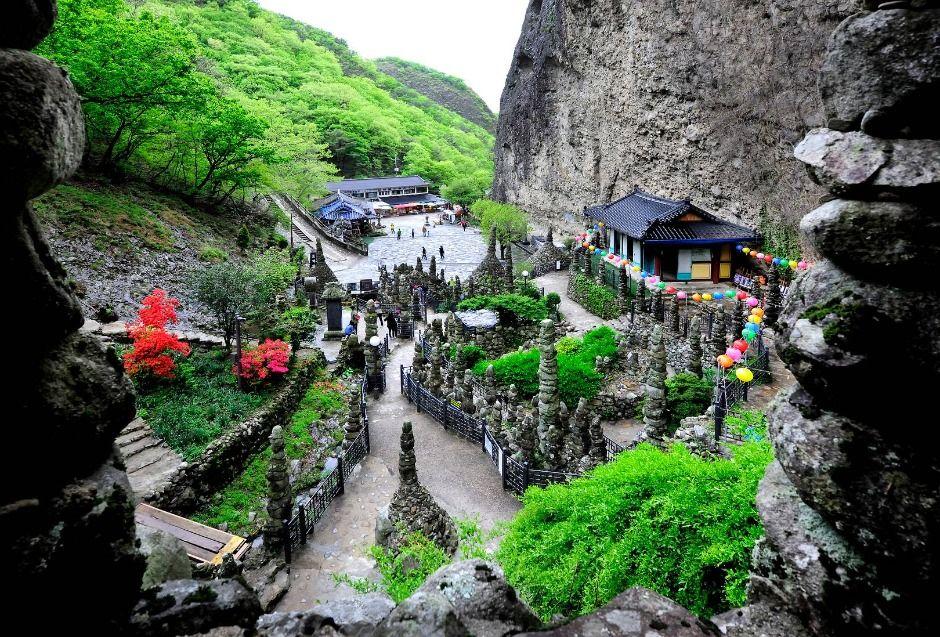
The main trail at Maisan is the north-to-south walk through the valley between the peaks, about 2.5 km one-way. You enter at the north parking lot, pass through Jinan town's cherry blossom road (which runs along the approach path), continue up through the valley, visit Eunamsa Temple (은수사) halfway through, and end at Tapsa. The full walk takes about 1 hour 30 minutes at a gentle pace. The trail is mostly paved or packed gravel — manageable for visitors of most fitness levels.
Hikers can also ascend Amabong (the female peak) via a separate trail from the north entrance — it's a steeper 40-minute climb with excellent views over the whole valley and the Jinan basin below. Sutbong (the male peak) is closed to the public to protect its ecosystem, which is home to rare plant species. Wear proper shoes for the Amabong trail — it involves some rocky sections and becomes slippery when wet.
The Spring Cherry Blossom Road
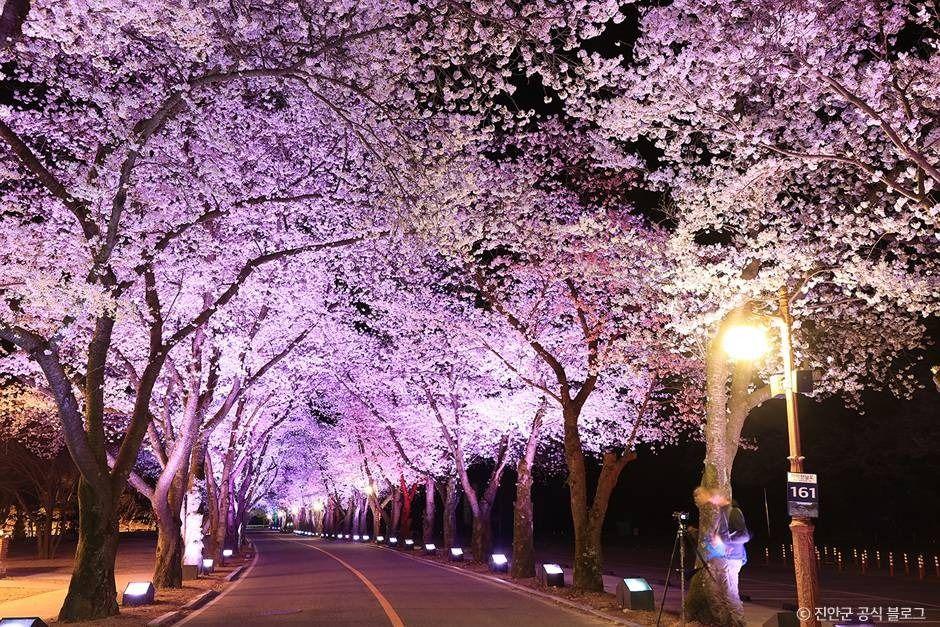
In late March and early April, the road leading to Maisan's north entrance becomes one of the most photographed drives in Jeonbuk Province. A long avenue of cherry trees forms a tunnel of blossoms over the road, and at night the county lights them in purple and white. It's a brief window — peak bloom lasts about a week — but the combination of cherry blossoms and the twin peaks rising in the background is the image most often associated with Maisan in Korean travel media.
If you're visiting outside spring, Maisan rewards year-round. Summer is lush and green, autumn brings excellent hiking weather and foliage, and winter is when the upward icicle phenomenon at Tapsa occurs — typically from late December through January. Spring is the most crowded, so if you visit in late March or early April, arrive before 9:00 to find parking without waiting.
What to Eat Near Maisan
Jinan town, just outside the north entrance, has a cluster of restaurants along the main street serving local specialties. Jinan is Korea's leading ginseng-producing county, and you'll see red ginseng products everywhere — from tea to pork ginseng stew. The local dish worth seeking out is 육회비빔밥 (yukhoe bibimbap) — rice topped with julienned raw beef, vegetables, and a fried egg. It's a regional North Jeolla specialty, lighter and more delicate than the versions served in Jeonju.
For something simpler, the vendors at the south parking lot sell jeon (Korean savory pancakes) and sik-hye (sweet fermented rice drink) — the sort of snack that's part of the Tapsa experience. Budget 15,000–25,000 KRW per person for a meal in Jinan town. The restaurants are casual and photo-menu friendly.
Quick Tips
- 1Park at the north entrance: Start there and walk south to Tapsa, so you end near the south parking lot — you can call a taxi back or arrange a car shuttle.
- 2Bring cash: The entry booths sometimes don't accept card for the parking fee — the ticket windows for the park entry usually do.
- 3Cherry blossom timing: Peak bloom typically falls in the last week of March to first week of April. Check Korean weather apps for the exact year.
- 4Winter visitors: The upward icicle phenomenon at Tapsa is typically visible from late December through January — arrive early morning for the best display.
- 5Combine with Jeonju: Jinan is 45 minutes from Jeonju Hanok Village. A Jeonju–Maisan day covers two of Jeonbuk's top attractions in one trip.
- 6Photography: The twin peaks photograph best from the approach road into town, about 2 km before the north entrance — this is where you get the classic "horse ears" symmetrical shot.
FAQ
Frequently Asked Questions
Maisan sits in a gap in English-language Korea travel content — written about endlessly in Korean but almost unknown to foreign visitors. The twin peaks are worth seeing just for the geological strangeness. Tapsa's mortar-free pagodas, standing for over a century, are worth seeing for entirely different reasons. And the cherry blossom road, if you time it right, is the kind of image that sticks. Leave Seoul by 8:00, arrive mid-morning, walk through to Tapsa, have lunch in Jinan, and you're back before dark.
Share this article
You Might Also Like


Get Travel Inspiration
Subscribe for new stories, route guides, and driving tips delivered to your inbox.